> ## Documentation Index
> Fetch the complete documentation index at: https://docs.blockops.network/llms.txt
> Use this file to discover all available pages before exploring further.
# Polkadot
> Public and private endpoints and example requests for Polkadot.
Polkadot is a blockchain platform that enables the creation of a network of interoperable and secure specialized blockchains called parachains. It addresses scalability, interoperability and governance by letting parachains communicate with each other under shared security.
### How to Connect to Polkadot
#### Using Public Endpoint
You can connect to polkadot using Blockops public API endpoints. These endpoints are only suitable for testing. Public RPC endpoints are not intended for dApp building. (Throughput rate limited to 50 rps).
We have different rate limits set for private API endpoints (e.g. ones with API keys attached) - Read more below
To avoid rate limiting and service interruption, [sign up now](https://app.blockops.network) to get your own API key.
For Polkadot Mainnet
```bash theme={null}
https://polkadot-public-rpc.blockops.network/rpc
```
For Polkadot Westend
```bash theme={null}
https://westend-rpc.blockops.network/rpc
```
For Polkadot Mainnet
```bash theme={null}
wss://polkadot-public-rpc.blockops.network/ws
```
For Polkadot Westend
```
wss://westend-rpc.blockops.network/ws
```
The below example uses the public API endpoint to make a request on the terminal
Using curl
```
curl -H "Content-Type: application/json" -d '{"id":1, "jsonrpc":"2.0", "method": "chain_getBlock"}' 'https://polkadot-public-rpc.blockops.network/rpc'
```
Using wscat
* Download wscat from [https://www.npmjs.com/package/wscat](https://www.npmjs.com/package/wscat)
* Install wscat by running the following command: `npm install -g wscat`
```
wscat -c 'wss://polkadot-rpc.blockops.network/ws' --header 'authorization: APIKEY xxxx'
```
#### Using Private Endpoint
Using API keys on an RPC node provides better tracking and monitoring of API usage.
Secure your data, speed up your queries, and take control of your API usage with our RPC API endpoint and personalized API keys. [Sign up now](https://app.blockops.network) to get your own API key.
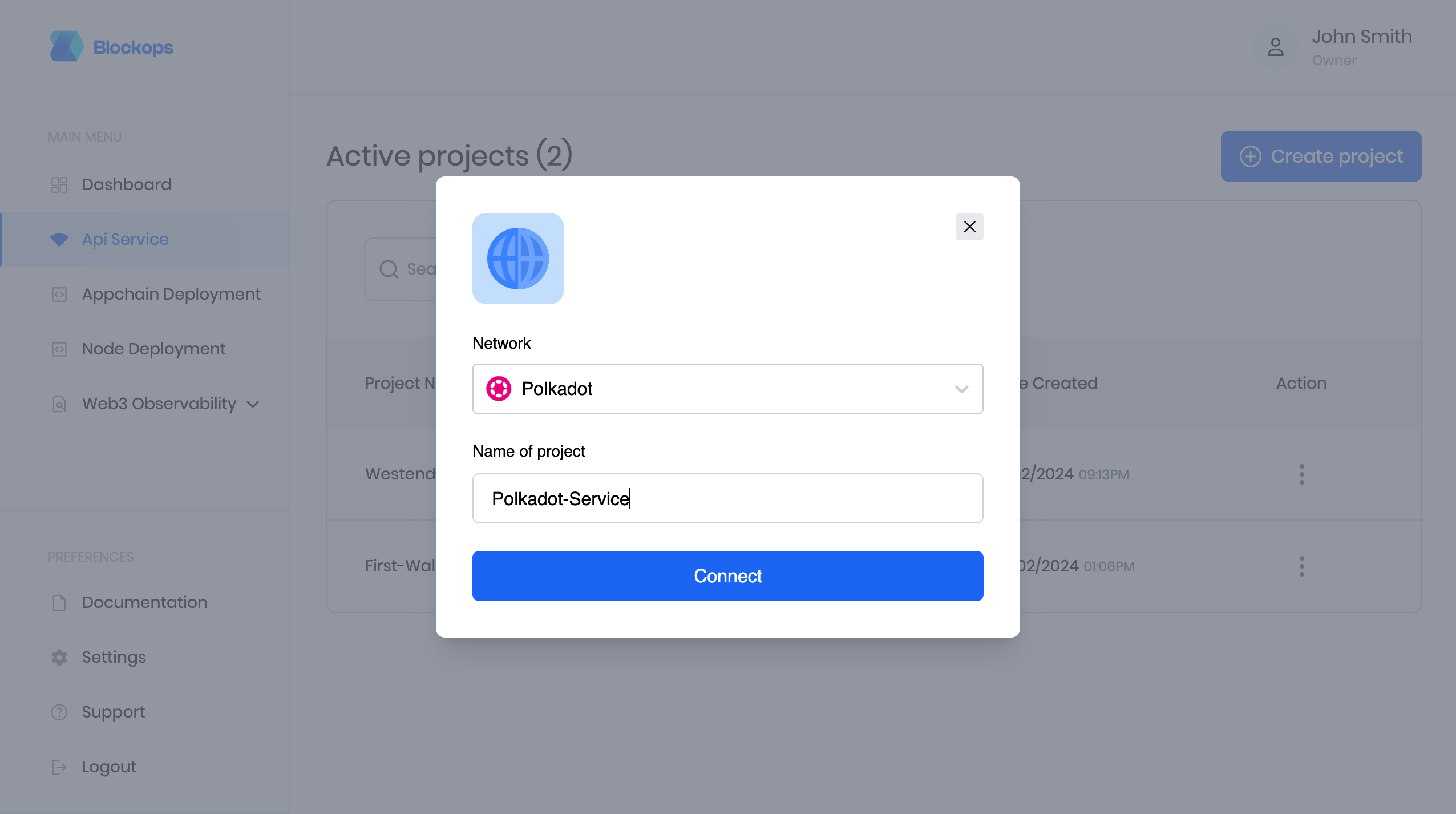
To get your API key, create a project using a unique Identifier as the project name and select Polkadot from the network options.
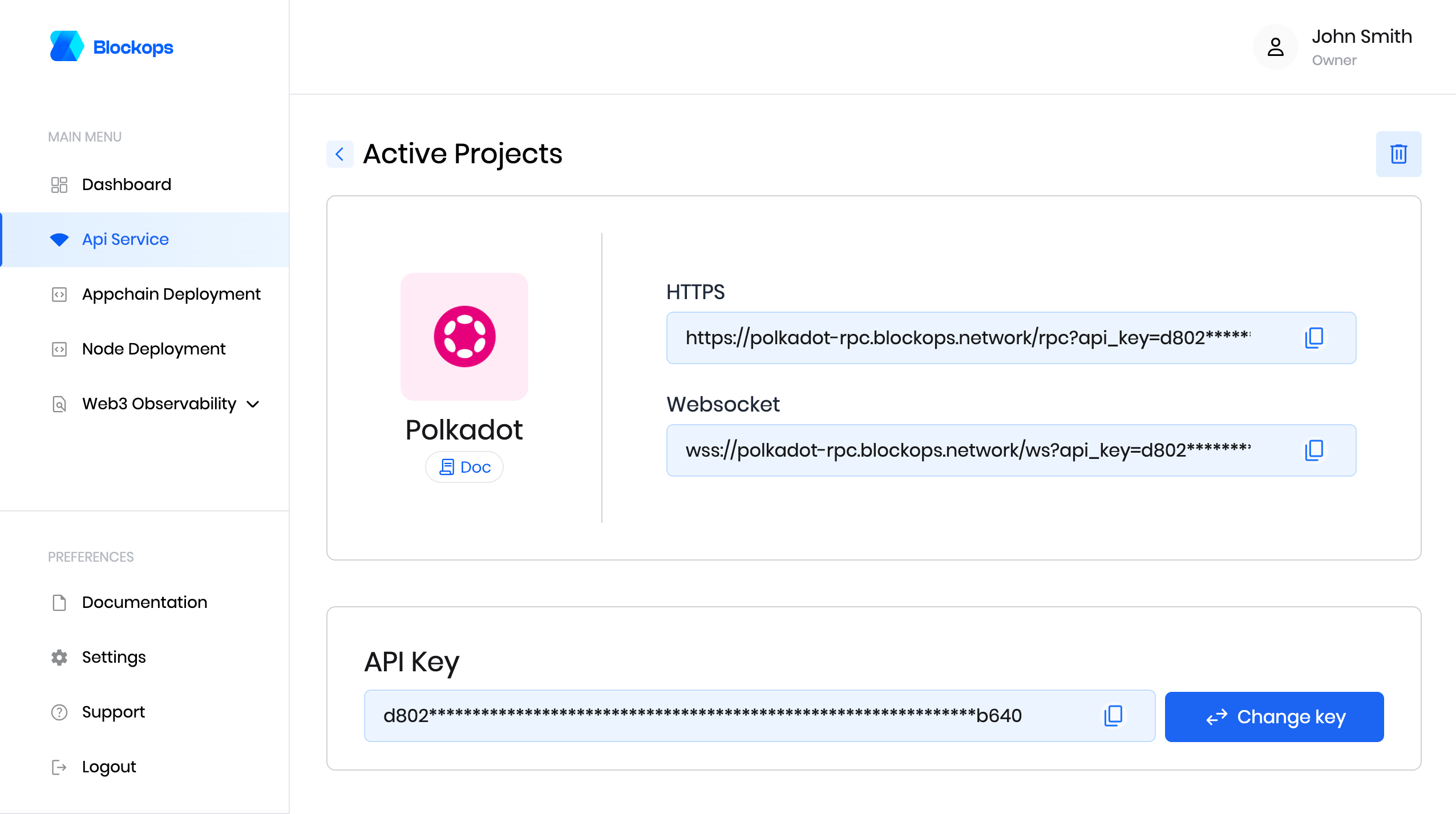
 Open the project to view your api key and rpc endpoints.
 #### Send requests
All requests are `POST` requests.
**Connect via Command Line**
You can connect to the network using websocket or HTTP with your API key in two ways:
* Adding the API key as a query string `?api_key=${APIKEY}`
* Or the request header `-H 'authorization: APIKEY ${APIKEY}'`
**Curl**
For example, the following CURL command can be used to get header and body of a relay chain block.
```bash theme={null}
curl -H "Content-Type: application/json" -H 'authorization: APIKEY xxxx' -d '{"id":1, "jsonrpc":"2.0", "method": "chain_getBlock"}' https://polkadot-rpc.blockops.network/rpc
```
Here is the response you will receive back.
```bash theme={null}
{"jsonrpc":"2.0","result":{"block":{"header":{"parentHash":"0x381dd358f0b1e328e861822b2a51a72e8dc064803a5c7ccc96277da3b16d7667","number":"0xe07a1d","stateRoot":"0xa2aacd7ef5d7ff66da1df6643b3e1c13975d210363c568f1bed51bad56cf40db","extrinsicsRoot":"0x00bc7f1504c9a07364835d80d2114ca3d4e7ad774453198b119bea9be2a1f7c1","digest":{"logs":["0x0642414245b50103d8000000d17aae1000000000768dc1931ba697bb9ab4a08debf5d710bd1f55e6325d65315161c2340cc0217170dfe2df24a3680c8ff48868ac665f4b34ebefa4bc844d510c848d9fc99252035db579a0acbf52cded336d6daf6ab7fdb1d1eee0d480e6388c2a12785d4de809"]},"justifications":null},"id":1}
```
**Wscat**
If you want to send data requests with WebSockets, you can use several libraries or wscat. You can install and use wscat as follows:
* Download wscat from [https://www.npmjs.com/package/wscat](https://www.npmjs.com/package/wscat)
* Install wscat by running the following command: `npm install -g wscat`
You can connect to the network with wscat using two options by adding the API key as a query string.
```bash theme={null}
wscat -c 'wss://polkadot-rpc.blockops.network/ws?api_key=*********************'
```
Or the request header.
```bash theme={null}
wscat -c 'wss://polkadot-rpc.blockops.network/ws' --header 'authorization: APIKEY xxxx'
```
After executing the command, the terminal will display a message indicating that the connection has been enabled successfully.
```bash theme={null}
Connected (press CTRL+C to quit)
>
```
Then, you can send the following request:
```
{"id":1, "jsonrpc":"2.0", "method": "chain_getBlock"}
```
For more information on the Polkadot network, please see the official [Polkadot developer documentation](https://wiki.polkadot.network/docs/getting-started).
Login or set up an account [here](https://app.blockops.network) to get started!
#### ***Quick Links***
[Website](https://polkadot.network)
[Github](https://github.com/paritytech/polkadot)
#### Send requests
All requests are `POST` requests.
**Connect via Command Line**
You can connect to the network using websocket or HTTP with your API key in two ways:
* Adding the API key as a query string `?api_key=${APIKEY}`
* Or the request header `-H 'authorization: APIKEY ${APIKEY}'`
**Curl**
For example, the following CURL command can be used to get header and body of a relay chain block.
```bash theme={null}
curl -H "Content-Type: application/json" -H 'authorization: APIKEY xxxx' -d '{"id":1, "jsonrpc":"2.0", "method": "chain_getBlock"}' https://polkadot-rpc.blockops.network/rpc
```
Here is the response you will receive back.
```bash theme={null}
{"jsonrpc":"2.0","result":{"block":{"header":{"parentHash":"0x381dd358f0b1e328e861822b2a51a72e8dc064803a5c7ccc96277da3b16d7667","number":"0xe07a1d","stateRoot":"0xa2aacd7ef5d7ff66da1df6643b3e1c13975d210363c568f1bed51bad56cf40db","extrinsicsRoot":"0x00bc7f1504c9a07364835d80d2114ca3d4e7ad774453198b119bea9be2a1f7c1","digest":{"logs":["0x0642414245b50103d8000000d17aae1000000000768dc1931ba697bb9ab4a08debf5d710bd1f55e6325d65315161c2340cc0217170dfe2df24a3680c8ff48868ac665f4b34ebefa4bc844d510c848d9fc99252035db579a0acbf52cded336d6daf6ab7fdb1d1eee0d480e6388c2a12785d4de809"]},"justifications":null},"id":1}
```
**Wscat**
If you want to send data requests with WebSockets, you can use several libraries or wscat. You can install and use wscat as follows:
* Download wscat from [https://www.npmjs.com/package/wscat](https://www.npmjs.com/package/wscat)
* Install wscat by running the following command: `npm install -g wscat`
You can connect to the network with wscat using two options by adding the API key as a query string.
```bash theme={null}
wscat -c 'wss://polkadot-rpc.blockops.network/ws?api_key=*********************'
```
Or the request header.
```bash theme={null}
wscat -c 'wss://polkadot-rpc.blockops.network/ws' --header 'authorization: APIKEY xxxx'
```
After executing the command, the terminal will display a message indicating that the connection has been enabled successfully.
```bash theme={null}
Connected (press CTRL+C to quit)
>
```
Then, you can send the following request:
```
{"id":1, "jsonrpc":"2.0", "method": "chain_getBlock"}
```
For more information on the Polkadot network, please see the official [Polkadot developer documentation](https://wiki.polkadot.network/docs/getting-started).
Login or set up an account [here](https://app.blockops.network) to get started!
#### ***Quick Links***
[Website](https://polkadot.network)
[Github](https://github.com/paritytech/polkadot)